If you've stopped letting your dog ride in the car — or you cringe every time someone opens your passenger door — this is worth nine minutes of your time.
The hair that won't vacuum out. The lint roller sheets piling up in your garage. That half-second where a passenger sweeps the seat before they sit down.
None of that is a cleaning problem. It's a physics problem, and almost nobody explains it to you.
Let me break it down.
I was giving a coworker a ride to lunch. Ten minutes, tops.
She opened the passenger door and did that quick, casual sweep of the hand across the seat before she lowered herself down. She was wearing black slacks. She was being practical. It wasn't rude.
I'd cleaned that car the night before. Forty minutes, shop vac, two lint rollers, a garbage bag of used tape sheets sitting in my garage as proof.
And it still wasn't good enough for a ten-minute ride to a sandwich shop.

My dog is a shepherd mix. Eight years old, seventy pounds, and he blows his coat twice a year like a dandelion in a wind tunnel. He also loves the car more than almost anything — the hardware store, the drive-thru, the twenty-minute trip to nowhere. He hears the keys and he's at the door.
For two years, I told him no.
I took the car to a detailer. Not a cheap one — a real shop with a waiting room. He opened the back door, ran his thumb across the upholstery, and made a face I'd seen before on my own reflection.
He quoted me $1,200. And then he told me he couldn't promise it would all come out.
"That's just embedded now."

He explained it like it was obvious. Car fabric isn't like a couch. It's a tight synthetic weave stretched over foam and heat-cycled every single day the car sits in the sun. Hair works its way in and stays in. He said he'd get the surface layer, maybe eighty percent, and the rest was structural.
Permanent.
I drove home doing math on what I'd already spent — the shop vac, the extractor attachment I used twice, the lint rollers, the ChomChom everyone swore by, the rubber broom, the two-pack of "pet hair gloves" from Amazon that were dish gloves with nubs on them.
Hundreds of dollars. And a professional had just told me the problem was unsolvable.
I believed him for eight more months.

A dog hair is not smooth. Under magnification, the shaft is wrapped in overlapping keratin scales — they lie flat in one direction like shingles on a roof, and they catch in the other.
When your dog lies down on a seat, his body weight doesn't rest hair on the fabric. It drives those scaled shafts down between the fibers, and the scales flare and catch on the way in.
Same principle as a fish hook. Same principle as a Chinese finger trap.
Easy in. Fights you on the way out.

Sebum — the natural oil in your dog's coat that makes him soft and shiny — is a lipid-based biological adhesive. It isn't water. It doesn't evaporate. It coats every shed hair and bonds that hair to synthetic fiber.
Then your car sits in a parking lot in July and the cabin climbs past 130°F. That oil softens, spreads into the weave, and sets again when it cools.
Every hot day, the bond gets a little more permanent.
Automotive upholstery is almost always polyester or nylon. Both sit on the far negative end of the triboelectric series — the same reason you get shocked closing your car door in winter.
Keratin, which is what dog hair is made of, sits on the far positive end.
Those two materials don't just touch. They cling, electrically, and the charge rebuilds every time your dog shifts his weight or you slide across the seat.
So stack all three: barbed, glued, and electrically bonded, inside a tight synthetic weave.
And what does a vacuum do about it?
That's the whole failure, in four words. Vertical suction on a barbed hair does exactly what pulling straight up on a fish hook does — the scales flare and dig in harder. The harder it pulls, the tighter the hair sets.
You're not extracting anything. You're compressing the embedded layer and removing the loose fluff sitting on top of it, then telling yourself you made progress.
That's why the seat looks clean when you finish and looks furry the second someone sits down.
Once you understand the mechanism, everything you've already bought starts to make a different kind of sense.
| What you tried | Why it can't work |
|---|---|
| Lint rollers | Adhesive grabs the surface layer only. Twenty sheets on one seat and every embedded hair stays exactly where it was. The refills are the business model. |
| Pet vacuums | Vertical suction, aimed the one direction that physically cannot release a barbed shaft. Beater bars wrap, tangle, and burn out. |
| Rubber brooms | Right idea, wrong instrument. Rigid, flat, and useless on seat bolsters, seams, and the crease where the back meets the base. |
| Cheap Amazon gloves | Dish gloves with nubs. Not enough surface texture to break the bond, so hair pushes around instead of gathering. |
| Professional detailing | $1,200 for roughly eighty percent, every few months, forever. |
None of these are scams exactly. They're just all aimed the wrong direction — and nobody in that chain has a reason to explain the physics to you, because explaining the physics ends the recurring revenue.
I got stuck on one detail while reading about all this: your bare hand already does it.
Everyone has had the experience of dragging a palm across a car seat and watching hair suddenly gather into a line. It works for about six inches. Then your skin stops gripping and it quits.
But it works for six inches. That's six inches of proof that the mechanism is real and every tool you own is aimed wrong.
So I went out at eleven at night with a flashlight. Instead of vacuuming, I put my hand flat on the back seat and dragged it sideways. Short strokes, same direction, the way you'd pet an animal.
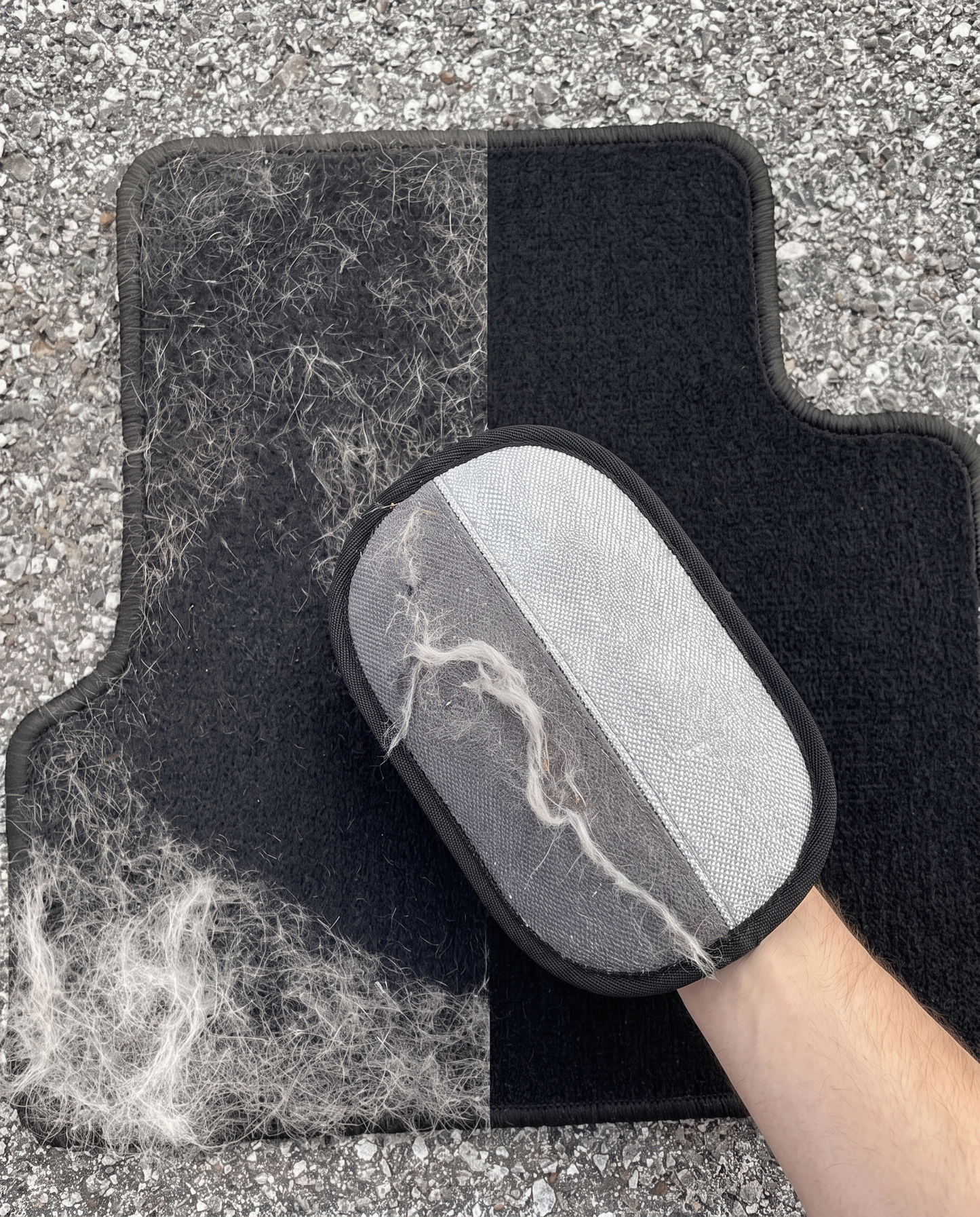
The seat I had personally certified as clean — the one my coworker wiped down before she sat on it — started producing a rope of hair.
Not fluff. Not dander. A dense grey-and-tan cord of embedded undercoat, rolling up under the edge of my hand, out of fabric a professional told me was finished.
The hair was never permanent. It was just aimed at wrong.
None of that is new science. It's the same physics that's been sitting in front of the whole category the entire time. It just needed to be built into something shaped like a hand.
A car interior is not a flat surface. It's bolsters, seams, headrests, the crease where the seat back meets the base, the strip of carpet under the pedals, and the cargo area lip that no attachment ever reaches.
Rigid tools skate over all of it. A vacuum head can't articulate. A lint roller can't get into a seam.
Your hand already knows the shape of your own car. That's the entire design argument.

At first glance it looks simple. Five fingers, a textured face, an adjustable strap. That's the point — no motor, no charging, no refill to reorder.
You slide it on and rub the seat the way you'd pet your dog.
The first thing you notice is drag.
Not resistance from the fabric — resistance from the hair. There's a faint gritty catch under your palm on the first pass, and that catch is the sound of a bond letting go. If you've only ever vacuumed, you have never felt it before.
Second pass, same direction, and something starts happening at the edge of your hand.
Hair that was invisible thirty seconds ago starts standing up out of the weave and rolling forward. Not floating into the air. Not scattering across the seat. Gathering — into a line, then a ridge, then a dense grey-and-tan mat sitting on the glove face like a piece of felt that was always in there waiting.

Then you pinch one corner and pull.
The whole thing comes off in one piece. Not shreds. Not a cloud you have to chase. A single strip you can hold between two fingers and drop straight in the trash.
I have watched people do this for the first time and I have never once seen someone not immediately do it again on the next section, just to see it happen twice.
A back seat takes most people ten to fifteen minutes. When you're done, you rinse the glove and hang it up. There is nothing to reorder — that's not a marketing angle, it's just what a reusable tool is.

The same motion works on the couch, on bedding, and on the black shirt you were about to give up on before walking out the door.
Anywhere hair has worked its way into a weave, the physics are identical — which is why most people stop keeping one in a drawer and start keeping one in each place they need it.


Probably true. Most people reading this have a pair of nubbed dish gloves in a drawer.
The difference is surface density and nub geometry. A gloves-with-bumps product has too few contact points and too little edge to catch a hair shaft — so hair pushes around instead of releasing and gathering.
Here's the honest test: if the hair doesn't collect into a strip you can peel off in one piece, the tool isn't generating enough lateral grip. That's the whole difference, and it's visible within about thirty seconds of use.
Which is exactly why the guarantee below is structured the way it is.
Picture the version of this where you don't think about it.
Someone asks you for a ride and you just say yes.
You take the dog to the park on a Saturday because he wants to go, not because you've scheduled a cleaning around it.
Your kid's friend gets in the back seat in light-colored clothes and nothing happens, because there's nothing there to get on them.
That's the whole thing. It's not really about the hair. It's about not having to choose between your dog and your car every single week.

Most people who order want more than one — one that lives in the car, one for the couch and bedding, one in the wash while the others are in use. So the offer is built that way. Order two, get a third free.
Now here's the part worth sitting with for a second.
The hair in your back seat right now is not staying the same. Every hot afternoon that car sits in a lot, the sebum on those embedded shafts softens, works deeper into the weave, and sets again when it cools. That's not a sales line — it's the same mechanism the detailer was describing when he said structural. The bond is getting stronger while you decide.
And your dog is shedding on a schedule that doesn't care about yours. If he blows his coat twice a year, one of those windows is always closer than you think.
So the real cost of waiting isn't a discount you might miss. It's another season of the same thing:
For context on what this replaces: the detailer wanted $1,200 for one visit, and told me up front it wouldn't all come out. Fifteen minutes and a glove you rinse and hang up is a different arrangement entirely.
This bundle is a promotional structure rather than the standing price, so it won't run forever. But there's no countdown on this page and nobody is going to tell you stock is about to disappear. If it's live when you're reading this, it's live.
Use it on your actual back seat. If it doesn't pull hair the vacuum left behind, contact us within 30 days for a full refund of the product price. Return shipping is the customer's responsibility.
THIS IS AN ADVERTISEMENT AND NOT AN ACTUAL NEWS ARTICLE, BLOG, OR CONSUMER PROTECTION UPDATE.
MARKETING DISCLOSURE: This page promotes a product sold by Koatly. The owner of this site has a financial connection to the product advertised.
NARRATIVE DISCLOSURE: The account presented on this page is a composite narrative created for illustrative purposes. Customer reviews shown are from verified purchasers. Individual results vary depending on fabric type, coat type, and level of buildup.
© 2026 Koatly. All rights reserved.

Koatly